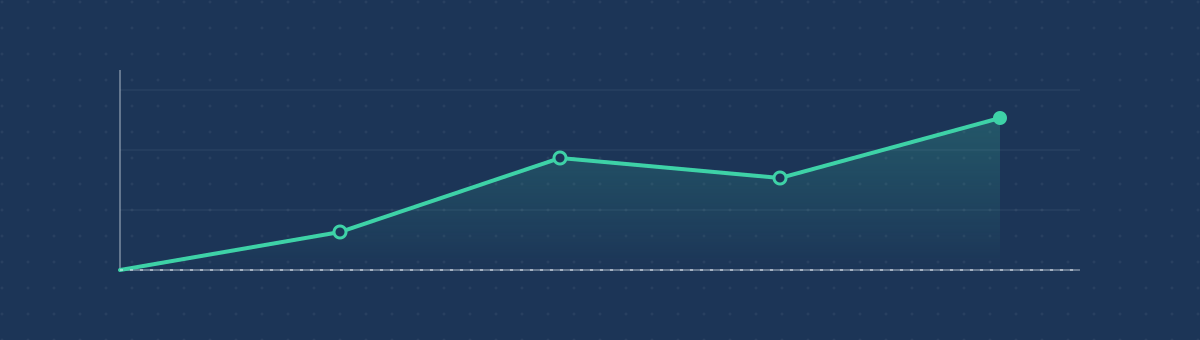
GEO takes months, not weeks, and the first phase is all impressions and no clicks. Here's the proof from our own site: in the first four weeks that Google Search Console recorded data, our articles picked up roughly 350 impressions in AI-influenced search results and exactly zero clicks, with every page sitting at position 70–100. That sounds like failure. It isn't. It's what the earliest, most normal stage of generative engine optimization actually looks like, and almost nobody publishes the real numbers for it.
Most "how long does GEO take" articles give you a confident range and no evidence. This one is the opposite: it's a transparent field report from a brand-new site, with the unedited Search Console data behind every claim. If you're doing GEO on a young domain and wondering whether the silence is normal, this is your benchmark.
Below: the exact impressions curve week by week, which pages are getting seen, what people are actually searching, why zero clicks is expected at this stage, and how to read your own Search Console the same way.
How Long Does GEO Actually Take?
For a new domain, expect three phases, and budget in months. First, indexing and impressions (weeks 1–6): your pages get crawled and start appearing deep in results for relevant queries; you'll see impressions climb while clicks stay at zero. Second, position climb (months 2–6): as the domain earns authority, pages move from page 8 toward page 1, and the first clicks arrive. Third, citations and compounding (months 4+): well-structured pages start getting pulled into AI answers and the topical cluster reinforces itself.
Our site is squarely in phase one. The honest headline number: four weeks of Search Console data, ~350 impressions, no clicks. Every figure below is real.
The Honest Baseline: Week-by-Week Impressions
Search Console started recording data for the site in mid-July 2026. Here is the weekly impression count since, the cleanest real series we have. Clicks were zero in every single week.
| Week | Impressions | Clicks | Avg position |
|---|---|---|---|
| Jul 19–25 | 44 | 0 | , |
| Jul 26 – Aug 1 | 86 | 0 | 69.8 |
| Aug 2–8 | 78 | 0 | 79.0 |
| Aug 9–15 | 103 | 0 | 78.5 |
The shape is the whole point: impressions more than doubled across the month while clicks never moved. A brand-new site being considered for more and more queries, but still ranking too deep to be clicked, is exactly the impression-first pattern you should expect in phase one. If you're seeing this on your own site, it's a green light, not a red one.
Which Pages Are Getting Seen?
Impressions are not spread evenly. One page does most of the work, and a page published mid-month started showing up within days, a useful signal on its own.
| Page | Impressions | Avg position |
|---|---|---|
| How to Get Cited in ChatGPT | 265 | 77 |
| Perplexity Citations Case Study | 28 | 54 |
| How ChatGPT Cites Sources (published Aug 10) | 23 | 71 |
| What Is GEO? | 13 | 85 |
| Homepage | 10 | 76 |
| Google AI Overviews Optimization | 10 | 84 |
| GEO vs SEO | 4 | 47 |
Two things stand out. First, our how to get cited in ChatGPT guide is the clear workhorse (265 of ~350 impressions come from that single page and its query cluster. Second, the two best-ranked pages (GEO vs SEO at position 47, the Perplexity case study at 54) are the ones with the sharpest, most self-contained structure) early evidence that the GEO signals we write about actually move position, even before authority catches up.
The page published on August 10 collecting 23 impressions within a week is a small but real confirmation that the site is being crawled promptly and that a tight hub-and-spoke cluster gets picked up fast.
What Are People Actually Searching?
The query data is the most useful part of the whole report, because it tells you whether your content is aimed at real demand. Ours is, the searches map cleanly onto the articles we've published.
| Query | Impressions | Avg position |
|---|---|---|
| how to get cited by chatgpt | 172 | 77 |
| get cited by chatgpt | 39 | 78 |
| how to get cited in chatgpt answers | 22 | 81 |
| perplexity citation gap analysis | 19 | 77 |
| how to get cited in chatgpt | 11 | 73 |
| google ai overviews optimization | 7 | 94 |
The demand is overwhelmingly clustered around one intent, getting cited in ChatGPT (which validates the hub we've built around it. But the long tail is where the surprises live. Buried in the same export were a few low-volume queries worth watching: a buyer-intent search (in French) comparing two rank-tracking tools, the branded query "rankgpt," and "perplexity ranking checker." Nobody plans for those, but they're a live signal that demand for AI-visibility tools is real and emerging) the kind of thing that quietly tells you what to write next.
Why Zero Clicks Isn't a Failure
A click happens when someone sees your result and chooses it. On Google, the overwhelming majority of clicks go to page-one results; almost none go to positions 70–100, which is page 7 and beyond. Our average position is in the high 70s. So zero clicks isn't a mystery; it's arithmetic. You cannot be clicked from page eight, no matter how good the page is.
What impressions do tell you is that the two hardest early problems are already solved: your pages are indexed, and they're being judged relevant enough to surface for real queries. That's the foundation everything else is built on. The job of phase two is to convert that relevance into rank, and rank, for a new domain, is mostly a function of authority and time. This is exactly why we've shifted focus from publishing more commercial pages to strengthening our workhorse article and building authority; ranking is the bottleneck, not relevance.
What's Actually Working After One Month
Stripping out the vanity, here's what the data genuinely confirms:
- Content-market fit. Every meaningful query maps to a page we published on purpose. We're not chasing traffic we can't serve.
- Structure moves position. Our two most tightly-structured pages already rank in the 40s–50s while the rest sit in the 70s–80s. Same domain, same age, the difference is on-page GEO structure.
- Fast crawling. A page published mid-month earned impressions within days, so indexing latency isn't holding us back.
- A compounding cluster. The "get cited in ChatGPT" hub and its spokes reinforce each other, and that hub is pulling the majority of all impressions.
None of that pays yet. But it's the correct set of leading indicators to have lit up at week four, and it tells us to keep going rather than change course.
How to Read Your Own Search Console the Same Way
If you're running GEO on a young site, don't judge yourself on clicks for the first couple of months; you'll only demoralize yourself. Here's the routine we use instead:
- Export Queries and Pages from Search Console (Performance report → the download button). Do it on a fixed cadence; we pull it roughly every two weeks and keep the CSVs.
- Watch the impressions trend, not the click count. In phase one, a rising impressions line is your real progress metric. Flat or falling impressions is the thing to worry about; zero clicks is not.
- Track average position in bands. Group pages into 1–10, 11–30, 31–50, 50+. Progress looks like pages migrating up a band over time, long before any click arrives.
- Identify your workhorse page. One page usually pulls most of your impressions. That's your highest-leverage page to strengthen and interlink toward, improving it moves the whole site's numbers more than a brand-new article will.
- Mine the long tail for what to write next. The odd, low-volume queries you never targeted are unfiltered demand signals. Ours pointed straight at AI-visibility tools.
For the on-page side of converting those impressions into rank and citations, see our complete guide to getting cited in ChatGPT and run every article through the GEO content checklist. For the controlled experiment behind which specific changes move AI citations, see how we got cited in 34 Perplexity answers in 30 days. And for the strategic framing of why this is a different game from traditional search, see GEO vs SEO. If Google's AI summaries are your target, our step-by-step guide to optimizing for Google AI Overviews covers the on-page work.
Frequently Asked Questions
- How long does GEO take to show results?
- For a new domain, plan on months rather than weeks. Impressions typically begin within the first few weeks of a page being indexed, but clicks and AI citations usually take two to six months as the domain earns enough authority to rank on page one. In our own first four weeks of Search Console data, we saw impressions climb steadily to around 350 with zero clicks, the normal impression-first phase.
- Is it normal to get impressions but zero clicks?
- Yes, for a new site it's the expected first stage. Impressions mean your pages are indexed and being surfaced for relevant queries; zero clicks simply means you're still ranking too deep (positions 70–100 are page seven and beyond, where essentially no one clicks). Rising impressions with no clicks is a sign of progress, not failure. The clicks follow once position improves.
- What position do you need to rank at to get clicks?
- Realistically, page one, positions 1–10, captures the overwhelming majority of clicks, and the top three take the lion's share. A page sitting at position 50 or 80 can accumulate impressions but will rarely be clicked. That's why, in the early phase, watching pages migrate up the position bands matters more than the click count itself.
- Should I judge my GEO progress on clicks or impressions?
- In the first couple of months, judge it on impressions and average position, not clicks. A rising impressions trend tells you Google is indexing your pages and finding them relevant for more queries over time. Clicks become the right metric later, once your pages start reaching page one. Fixating on clicks too early gives a misleading picture of a site that's actually progressing.
- How often should I check Google Search Console for a new GEO site?
- Roughly every one to two weeks is plenty. Search Console data lags by a couple of days and moves slowly on a new site, so daily checking mostly produces noise and anxiety. We export the Queries and Pages reports on a fixed cadence, keep the CSVs, and compare windows to see the impressions trend and position changes over time.
- Does zero clicks mean my content or GEO structure is wrong?
- Not on its own. If you're getting impressions, your indexing and relevance are working, the bottleneck at that point is almost always domain authority and rank, which take time. The way to tell whether your structure is good is to compare pages: if your best-structured pages rank meaningfully higher than your weaker ones at the same site age, your on-page GEO is doing its job and you mainly need authority and patience.
- What can I do to speed up GEO results?
-
Get indexed fast (submit your sitemap and request indexing), make sure AI crawlers like
OpenAI's
OAI-SearchBotare allowed, write self-contained answers with question headings and FAQ schema, and concentrate on building topical authority in a tight niche rather than spreading thin. Off-page authority, earning links and a direct audience, is the biggest lever for moving position, and it's the part no on-page change can shortcut.